

Have you ever noticed those airport photos that look like they belong in a fashion editorial or a high end travel campaign? The kind of images that encapsulate the spirit of travel, the anticipation, the quiet thrill of departure, and the traveler’s personal style, all in a single frame. As photographers, we understand that an airport is far more than a transit hub; it’s a dynamic visual stage filled with creative potential. From sleek contemporary architecture to the soft, directional natural light pouring through expansive glass windows, it offers everything needed to produce imagery that feels refined, emotive, and editorial ready.
In this article, we’ll share five creative concepts for capturing striking airport photographs, whether you’re working with a client, documenting your own journey, or producing content for social media. The key lies in developing a trained photographic eye: observing intentionally, composing with leading lines, experimenting with reflections, and leveraging color contrast. Just as important is the ability to guide your subject, whether through deliberate posing or by anticipating authentic, candid moments. Make the most of that pre flight downtime and transform it into an opportunity to create images that feel effortless yet thoughtfully composed. Ready to turn the airport into your next photographic set? Let’s dive into ideas that truly deliver.
1. Make the most of natural light through the floor to ceiling windows


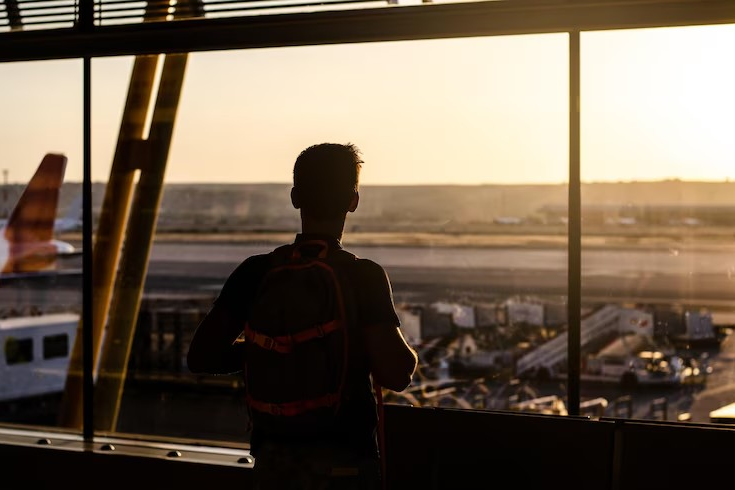
One of the greatest advantages of shooting in airports is the abundance of natural light streaming through their expansive glass windows. This soft, diffused illumination is ideal for portraiture, as it minimizes harsh shadows and renders skin tones with accuracy and subtlety. As any photographer knows, light quality is everything, and these spaces, almost unintentionally, function as massive natural softboxes. Knowing how to position yourself in relation to these light sources can be the difference between an ordinary image and one with a polished, professional impact.
Look for areas where the light falls from the side or at a diagonal angle, as this creates depth, dimension and texture on your subject. When working with a model, position them close to the window and pay close attention to the direction of light based on the mood you want to achieve: front facing light will produce a softer, more enveloping look, while side lighting introduces contrast and a more dramatic feel. You can also use the floor patterns or surrounding furniture to create leading lines that guide the viewer’s eye toward your subject. Incorporating these architectural elements not only adds visual interest but also conveys a sense of scale and spatial context, enriching the overall narrative.
Timing plays a crucial role in the final aesthetic. During golden hour, sunrise or sunset, the warm light can wash over the terminal, creating a golden ambiance that’s perfect for emotive or editorial style imagery. If you’re traveling at these times, consider arriving early to scout and pre visualize your compositions. Depending on how you build your frame, you can produce minimalist shots or more complex scenes by incorporating silhouettes, backlighting, or even natural lens flare for a cinematic look.
Be mindful of your exposure settings, especially when dealing with bright backgrounds. A useful approach is to expose for your subject and allow the highlights in the background to clip slightly if it supports a clean, high key aesthetic. You can also use a portable reflector, or even a white garment, to bounce light back onto your subject and soften shadows. Ultimately, with careful observation and a bit of patience, airport light can become one of your most powerful tools for creating professional, authentic images with a distinctive atmosphere.
2. Capture motion with long exposures


The airport is one of the most dynamic environments you can photograph: travelers moving with urgency, rolling luggage, departure boards constantly updating, and aircraft taking off in the distance. This continuous flow of motion presents a perfect opportunity to experiment with long exposures, a photographic technique capable of transforming a chaotic scene into something intentional and visually compelling. In a setting like this, long exposure allows you to interpret the energy of travel in a creative way, emphasizing the contrast between stillness and movement.
To achieve a successful long exposure shot, you’ll need to slow down your shutter speed, typically anywhere from 1/2 second to several seconds, depending on the effect you’re after. This requires a camera with manual controls, ideally mounted on a tripod or stabilized on a solid surface to eliminate camera shake. The goal is to anchor a fixed point within the frame, such as a seated subject or a static object, while everything else dissolves into motion trails. The result is a cinematic aesthetic that works beautifully in black and white or when graded with cooler tones.
Airport terminals, moving walkways, and even security checkpoints can serve as excellent backdrops for this technique. If you plan to include people in your compositions, be mindful of privacy considerations, or work with models if the images are intended for commercial use. A practical approach is to shoot multiple frames in succession, varying your shutter speeds until you find the perfect balance between sharpness and motion blur. You can also explore intentional camera movement (ICM) for a more abstract and expressive result.
Beyond its visual impact, this technique adds narrative depth, it captures the rhythm of travel, the tension of waiting, and the passage of time. Incorporating these elements into your work demonstrates both technical control and a more conceptual photographic vision. Long exposures in airports don’t just create striking images, they tell moving stories in a way few locations can. So next time you’re waiting for your flight, set up your camera, dial in your shutter speed, and let time paint the frame.

3. Use your luggage as a part of the composition


Luggage isn’t just a functional object, it can also become a powerful visual element within your compositions. Whether it’s a sleek, minimalist suitcase, a weathered backpack shaped by travel, or a statement bag with character, luggage instantly provides context: it speaks of movement, destination, and story. For a photographer, any object that enhances narrative and strengthens composition is an invaluable tool, and the airport offers countless opportunities to integrate it in a creative, aesthetically compelling way.
A classic and effective approach is to use the suitcase as a point of interaction for your subject: sitting on it, leaning against it, pulling it, or walking with it in backlight. These gestures introduce a sense of action and direction, conveying that evocative “on the move” mood that resonates so well with viewers. You can also experiment with perspective by placing the luggage in the foreground and using a wide aperture to blur the background, creating depth and selective focus. This type of framing works particularly well for social media content and editorial lifestyle portfolios.
Don’t underestimate the visual impact of color and texture. A bold red suitcase against a neutral floor, a leather backpack contrasting with metallic architecture, or a vintage bag resting on a modern bench can all create striking visual tension. You can also explore monochromatic or complementary color palettes based on your subject’s wardrobe and the surrounding environment. In professional photography, every element within the frame should serve a purpose, so if you include luggage, do so with clear intent.
If you’re documenting your own journey, incorporating your luggage can also humanize the image, making it feel more intimate and relatable. Showcase the backpack that’s traveled with you across destinations, or that brand new suitcase that suggests a story just beginning. These kinds of images are ideal for building a cohesive visual narrative around your identity as a travel photographer. Luggage isn’t merely an accessory: it’s a symbol. And as a visual storyteller, you know that when symbols are used thoughtfully, they can elevate an image beyond aesthetics and communicate meaning without a single word.

4. Experiment with reflections on floors and windows


One of the most photogenic aspects of modern airports is their clean, polished architecture, often defined by glossy floors, expansive glass walls, and highly reflective surfaces. These features don’t just enhance the environment; they become powerful creative tools for building compositions with symmetry, depth, and visual impact. As a professional photographer, you know that reflections, when used with intention, can elevate an image from strong to truly striking, and the airport is an ideal setting to refine this approach.
Polished floors, especially when freshly cleaned or illuminated by natural light, act like mirrors that duplicate the scene. This opens the door to highly engaging symmetrical compositions. A full body portrait with a perfectly aligned reflection, for instance, conveys balance, order, and visual harmony. You can also experiment with top down angles or shoot from a low perspective to exaggerate the sense of space and introduce a slightly surreal quality. Pay close attention to floor cleanliness and light direction to avoid unwanted glare or distracting imperfections.
Large windows are equally powerful, particularly when they capture reflections from both the interior and exterior simultaneously. This allows you to create layered compositions where the subject’s reflection, the outside landscape, and elements within the terminal merge into a single, visually rich narrative. These images often translate beautifully into black and white, where contrast helps define shapes and silhouettes. Incorporating human figures can further enhance scale and introduce a more intimate or dramatic atmosphere.
Working with reflections also invites a more conceptual perspective: the idea of duality, of being in between places, of departure and hesitation, of waiting versus movement. All of this can be communicated visually, without the need for explanation. Just be mindful to keep your composition clean, balance your exposure carefully, and ensure the reflection enhances rather than distracts. When seamlessly integrated into your visual narrative, reflections can become one of your most compelling aesthetic and emotional tools, perfect for crafting truly memorable airport imagery.

5. Capture the moment of the boarding in a documentary style
The moment just before boarding is one of the most emotionally charged instances within an airport, filled with farewells, anticipation, nervous energy, and the quiet excitement of what lies ahead. From a photographic standpoint, approaching this scene with a documentary mindset can yield images that feel honest, layered, and deeply narrative. It’s about letting go of perfectly staged poses and embracing spontaneity, capturing what is real as it unfolds. This approach is particularly powerful for visual storytelling, whether in travel photography, personal projects, or editorial work.
To work effectively in this style, observation and anticipation are essential. The boarding process moves quickly, so you need to be ready, camera dialed in with a fast shutter speed, balanced ISO, and a versatile lens such as a 35mm or 50mm. The goal is to capture authentic expressions and subtle gestures: a lingering glance toward the runway, a nervous smile, a hand gripping a passport, or the quiet stride toward the jet bridge. These seemingly simple details carry emotional weight and create a strong connection with the viewer.
You can draw from street photography techniques, layered compositions, intentional blur, or even low angle perspectives to add dynamism. The surrounding environment becomes part of your storytelling toolkit: departure signs, boarding gates, information screens, and even the queue of passengers all contribute context and depth. If you’re photographing a specific subject, consider capturing candid moments first, then, if needed, guiding a subtle reenactment to refine the frame without losing authenticity.
This documentary approach holds particular value when building a cohesive travel narrative, a visual journal, or a photographic essay. Boarding symbolizes transition, the threshold between chapters, and capturing it with visual honesty strengthens the narrative arc of any image series. It’s not just about creating a beautiful photograph, but about telling a story through each frame, something that distinguishes a professional photographer from an amateur. More often than not, the most compelling images aren’t the ones you plan, but the ones that reveal themselves when you’re fully present, camera in hand, and attuned to the extraordinary within the everyday.

Take your travel photography to the next level with these ideas
Wrapping up this journey through five creative airport photography ideas is really just the beginning of a deeper visual exploration. Every terminal, waiting area, and boarding bridge presents unique opportunities to capture moments that speak of departure and arrival. If this article has sparked your creativity, we invite you to continue exploring our blog, where you’ll find advanced techniques, practical insights, and interviews with photographers who have successfully turned their passion into a profession.
To further develop your skills and elevate your craft, consider the courses offered by Master Class Photographers. For instance, the course Curso Online de Fotografía con Christian Macías: Un Día de Sesión provides a comprehensive look into a professional photographer’s workflow, from initial concept and planning to final image delivery. If you’re looking to refine your lighting techniques using minimal gear, Aprende a Iluminar con Bajos Recursos is an excellent option. And for those interested in specializing in event photography, the Curso en Vivo por Zoom de Fotografía de XV Años con The Padillasdelivers targeted knowledge for capturing meaningful, once in a lifetime moments. These courses are designed to suit different experience levels and will help you expand your portfolio with impactful, professional quality imagery.


