

Capturing a gaze can be just as powerful as photographing a full face. Eyes reflect emotions, personality, and energy, and focusing on them can lead to truly memorable photographs. This article is for you, professional photographer or enthusiast, who wants to experiment with more intimate shots, specific lighting techniques, and compositions that enhance the beauty and depth of the eyes. We’ll give you five practical and creative ideas that you can apply to your sessions, both in the studio and outdoors.
Whether you work with artistic portraits, conceptual photography, or simply want to add variety to your portfolio, exploring eye photography will open up a new world of visual possibilities. From reflections that tell stories to macro shots that reveal incredible textures of the iris, here you’ll find inspiration and technical tips to help you achieve stunning results. Ready to see beyond a simple glance?
1. Extreme close-ups: discover the universe in an iris


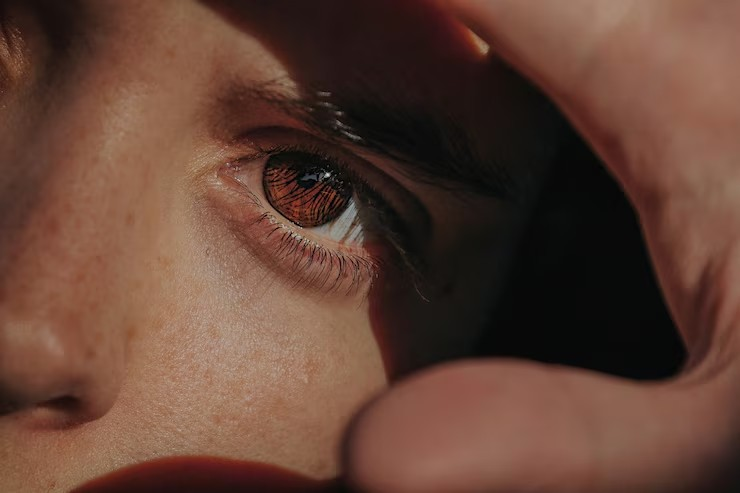
One of the most striking exercises for any photographer is capturing an extreme close-up of the human eye. The iris, with its complex mix of textures, colors, and shapes, can appear almost like a miniature galaxy. This type of photography is not only visually stunning but also allows you to explore macro photography techniques with an artistic approach. If you want to create images that captivate the viewer, starting with this approach is ideal.
To achieve this type of shot, you’ll need a macro lens with an appropriate focal length (60mm, 90mm, or 100mm are common options), or, if you’re a beginner, a regular lens with extension tubes can also work. The key is to achieve a very precise depth of field, since in close-ups, even the slightest movement can blur the subject. Use a tripod, manual focus lock, and, if possible, a remote shutter release or timer to avoid camera shake. The focus should be directly on the iris, not on the eyelashes or eyelid.
Lighting is another fundamental element. Work with soft, diffused light to avoid harsh reflections, but also consider using a ring light to create circular highlights in the pupil that add drama. If you want to experiment even further, you can use colored LED lights to project different hues onto the iris for unconventional results. However, avoid very intense or direct lighting that could make the model uncomfortable or cause them to constantly close their eyes.
This type of photography is ideal for standing out on social media, in artistic projects, or even in advertising campaigns for products related to vision or makeup. It can also be a creative way to start a personal series based on portraying identity through the eyes. The important thing is to develop your eye for detail: every iris is unique, and your lens is the perfect tool to reveal it. Dare to see what no one else sees and let your eye photos speak for themselves.

2. Play with reflections: stories seen in the eyes


Eyes not only express emotions, they are also surfaces that reflect the world. Capturing reflections in the human eye can result in images full of narrative and visual depth. From a window with soft light to an entire scene projected onto the pupil, reflections can become silent protagonists that tell a parallel story. This technique allows you to play with composition without altering the direct gaze, taking advantage of what is happening in front of the model to generate a second layer of meaning in the photograph.
To achieve this, you must pay attention to two main elements: the light source and what is reflected. Natural light entering through a window or a large picture window is ideal for this type of shot, as it creates a broad, soft, and well-defined reflection. You can experiment by placing the subject in front of landscapes, urban scenes, people, or even architectural structures that you want to reflect. It is also helpful to plan the shot, knowing beforehand what you want to appear within the eye. An important tip: position the face at an angle that captures the reflection without losing focus on the iris.
In terms of technique, work with small apertures (f/4 to f/8) to achieve greater sharpness in the details of the reflection, without losing depth of field. Use a lens that allows for a medium focal length to maintain the realistic proportion of the eye within the frame (for example, a 50mm or 85mm lens on full-frame cameras). If using artificial light, position it to the side and keep it from being too strong to avoid white spots that saturate the image or obscure the reflection you want to highlight. The use of polarizers is not recommended in these cases, as they could eliminate precisely the reflections you wish to capture.
Beyond the technical aspects, this idea allows you to create conceptual photographs with great artistic value. You can depict interior landscapes—like a library or a living room—within the eye, or project symbolic images such as a lit candle or a sunset. In editorial projects, this technique is used to convey ideas such as introspection, memory, or emotional connection. As a photographer, playing with reflections invites you to observe the environment more attentively and take advantage of every reflective surface as another expressive resource in your creative arsenal.

3. Symmetrical composition: the look as the center of attention


Symmetry is a powerful tool in photography, especially when it comes to photographing eyes. Using a symmetrical composition with the eye (or both) as the central point creates a strong visual impact, immediately capturing the viewer’s attention. This type of framing conveys order, balance, and strength, and is especially effective in portraits where the gaze seeks to connect directly with the viewer. In sessions where the face is the focus, placing the eyes on the central axis can help communicate intensity and presence.
To achieve an effective symmetrical composition, you must ensure that the frame is perfectly level. Use the grid or guidelines on your camera’s screen to align the eyes horizontally, and center one or both in the frame. If you are working with only one eye (for example, a side close-up), make sure that the surrounding elements are visually balanced. This can be achieved using lines, shadows, or neutral backgrounds that reinforce the focus on the gaze. If you want an even more polished image, correct the symmetry in post-production, but without exaggerating to the point of losing its natural look.
In technical terms, you can use 85mm or 100mm lenses for close-up portraits, as they allow for good compression of facial features without distortion. Choose a mid-range aperture (f/4 – f/5.6) to maintain sharpness in both eyes, especially if they are at the same distance from the camera. Pay close attention to lighting as well: in this type of photo, soft frontal light (such as a large diffuser or a window in front of the subject) helps maintain symmetry in the shadows and highlights of the eyes. A reflector placed underneath can further soften the shadows in the eye area.
This technique is ideal if you are looking for powerful portraits for portfolios, fashion photography, or conceptual art. A direct, well-framed, and technically sound gaze has the power to evoke intense emotions: from connection to mystery. Furthermore, symmetrical compositions create visual harmony, which is perfect for standing out on social media platforms like Instagram, where centered images tend to attract more attention. So the next time you’re looking at a face, think of the gaze not just as a detail, but as the axis that holds the whole image together.

4. Dramatic lighting: shadows and light to highlight emotions


Lighting is one of the most powerful tools for transforming a photograph of eyes into an emotionally charged work of art. Through light and shadow, you can create intense, mysterious, or even cinematic atmospheres that enhance the expressiveness of the gaze. Working with dramatic lighting allows you to highlight textures, iris colors, expression lines, or even tears, depending on the concept you’re aiming for. It’s an ideal technique for artistic portraits, editorial work, or personal projects with a more emotional and narrative focus.
The starting point is defining the direction and intensity of the light. A side light source, such as a window or a continuous light positioned at a 45° angle, creates deep shadows that add volume and drama. You can also use Rembrandt lighting or split lighting to emphasize one eye, leaving the other in shadow. If you want a more cinematic style, experiment with cool or warm tungsten lights and play with the color temperature. The stark contrast between light and shadow will make the eye appear more three-dimensional and intensify the expression.
As for equipment, you can work with adjustable LED lights, flashes with softboxes, or even homemade lamps modified with homemade diffusers like tracing paper or white fabric. The important thing is to maintain control over the light beam to direct it exactly where you need it. A flashlight with an improvised snoot, for example, can help you illuminate only the eye, leaving the rest of the face in shadow. Remember also that the environment can act as a modifier: dark walls absorb light, while white surfaces reflect it. Use this to your advantage to shape the atmosphere of the shot.
This style works very well when you want to convey introspection, melancholy, intensity, or even mystery. Furthermore, photos with dramatic lighting tend to stand out on social media due to their artistic nature. As a photographer, it allows you to break with convention and explore new visual languages. It’s also an excellent opportunity to experiment with black and white editing, further enhancing contrast and textures. Thus, each gaze is not only seen: it is felt. Dare to play with shadows and you will discover that light, when used well, not only illuminates… it also excites.

5. Eyes in motion: capturing natural and spontaneous glances
Sometimes, the most striking photos of eyes aren’t the perfectly focused or calculated ones, but those that capture a gaze in motion, amidst laughter, surprise, or spontaneous emotion. Eyes are dynamic by nature: they blink, glance sideways, focus, and dilate. Instead of fighting against this movement, you can make it part of the visual narrative of your portraits. This idea seeks to break with static images and allow gazes to flow more organically, offering images full of life and authenticity.
To achieve this, the first step is to change your approach as a photographer. Instead of giving rigid instructions, create a relaxed environment where the subject feels free to move, laugh, turn around, or simply interact with their surroundings. This is especially useful with children or people who aren’t used to being in front of a camera. Observe their natural gestures and shoot when you see an emotional shift reflected in their gaze. Use burst mode if necessary, as these moments often last only seconds.
From a technical standpoint, it’s advisable to use fast shutter speeds (1/250 or faster) to freeze motion without sacrificing sharpness. If you’re using natural light, make sure you have enough illumination to compensate for that speed. If you’re indoors or in low light, you can use a fill flash or a continuous LED light source that isn’t intrusive. Continuous autofocus (AF-C or AI Servo) is also useful if you’re shooting portraits with subtle movement. A 50mm or 85mm lens is ideal for maintaining a comfortable distance without sacrificing emotional intimacy.
This type of photography is highly expressive. A pair of eyes looking to the side while someone speaks, or twinkling with laughter in a half-blink, can convey more than a perfectly centered image. In lifestyle, couple, or documentary portrait sessions, this technique enhances naturalness and connects deeply with the viewer. Remember: not all gazes need to be direct or fixed. Sometimes, the most powerful thing happens when the eye is in motion, showing that there is a living story behind every blink.
Conclusion
Make sure every look counts. Capturing the eyes is much more than achieving a sharp image; it’s telling a story in a fraction of a second. With these five ideas, you have a wealth of possibilities at your fingertips to explore the human gaze from multiple angles: detail, emotion, symmetry, drama, and spontaneity. Whether you work with artistic, editorial, commercial, or personal portraits, focusing your efforts on the eyes can yield profound visual and emotional results. The key is to observe with intention, light with purpose, and shoot with sensitivity.


