
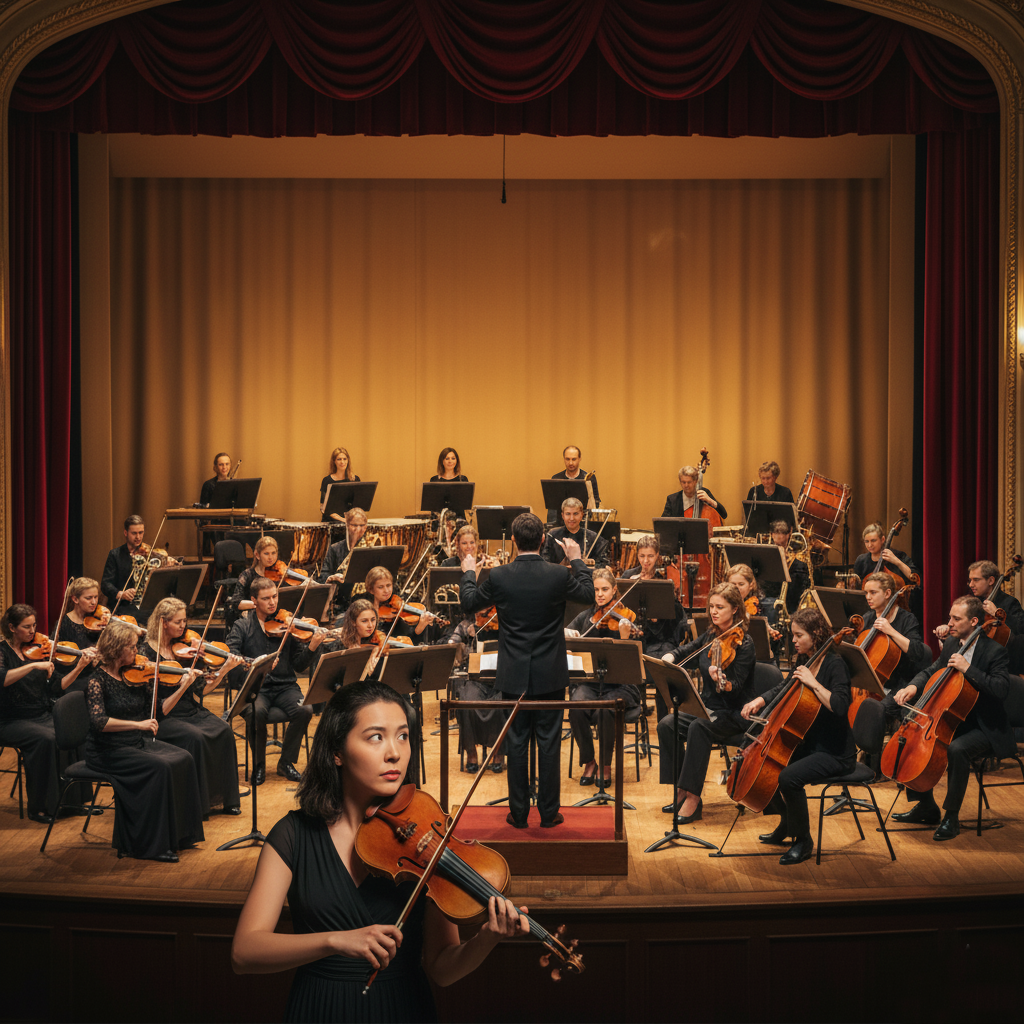
Photos with an orchestra possess a unique magic: they capture not only the harmony of the instruments but also the emotional connection between the musicians who bring the music to life. Unlike individual photographs, group images in an orchestral setting require careful composition, where every gesture, glance, and posture contributes to a visual narrative of balance, elegance, and artistic passion. A good pose can transform an ordinary rehearsal into a scene charged with energy and beauty, where the music seems to flow beyond the frame.
The environment in which the session takes place also plays a fundamental role. A classical theater, a modern concert hall, or even an open space can influence the emotional tone of the photograph. The lighting should highlight the details: the gleam of the metal on the wind instruments, the texture of the strings, or the reflection of the varnish on the violins. The key is to capture the interaction between the musicians, the conductor, and the surrounding atmosphere, conveying the synchronicity that characterizes an orchestra.
Beyond technique, the poses must reflect what it means to be part of a musical ensemble: the discipline of rehearsal, the dedication to performance, and the communion with the sound. In each image, there is a shared story, a moment in which music becomes a visual language.
1. Capturing the collective concentration
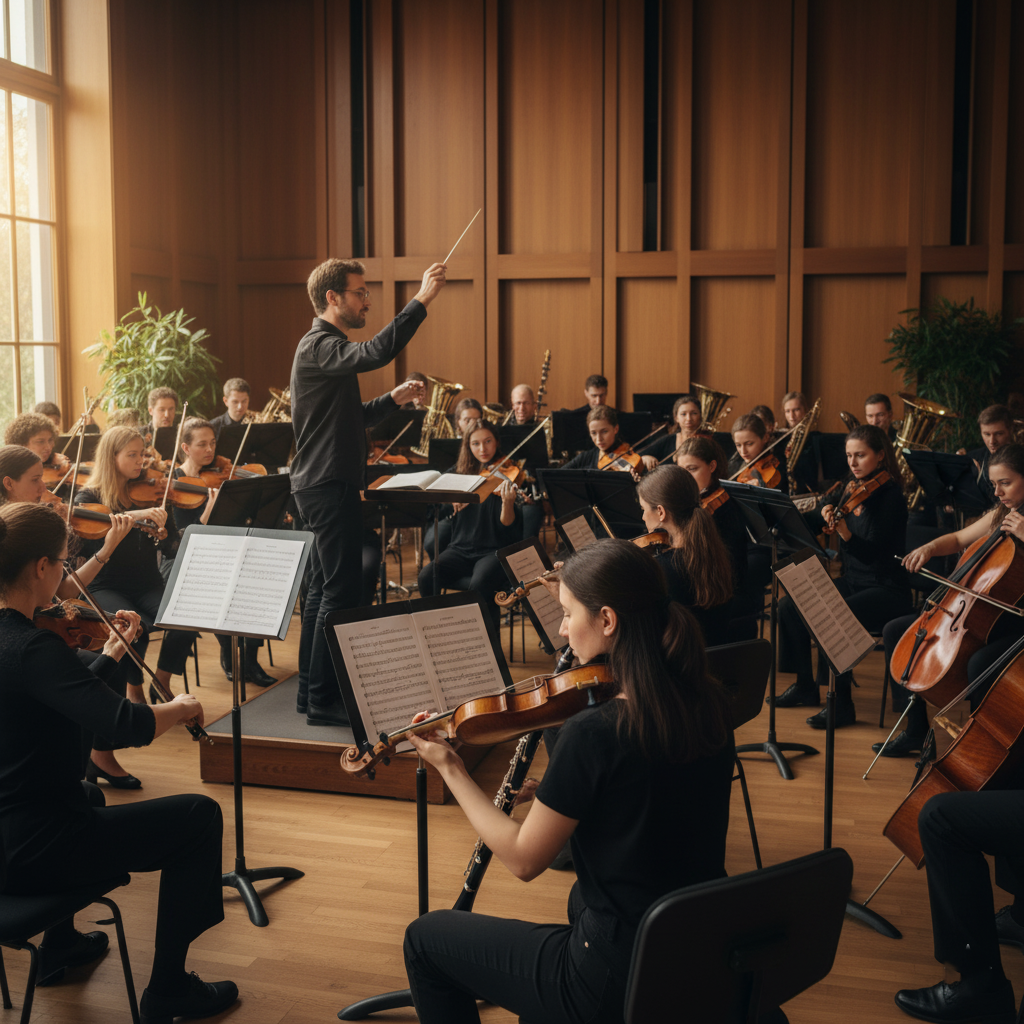
One of the most powerful poses for photographing an orchestra is one that immortalizes the moment of rehearsal. Far from the glitz of the stage, this moment reflects the essence of teamwork, discipline, and the invisible connection that unites the musicians. The ideal pose captures the performers focused, each one concentrating on their instrument, with the conductor at the front, guiding with expressive and purposeful gestures. It’s not about posing in the traditional sense, but about freezing the authenticity of the preparation, where every glance, every breath, and every movement builds an atmosphere of absolute commitment to the music.
The photographer should look for angles that convey depth and visual harmony. A slightly elevated shot can show the semicircular arrangement of the musicians, while a side view or one from behind the conductor offers an intimate perspective, almost as if the viewer were part of the ensemble. Soft, directional lighting helps to highlight the focused faces, the gleam of the instruments, and the texture of the surroundings without sacrificing naturalness.
This pose doesn’t require rigidity; The charm lies in the spontaneity of the gestures: a violinist tuning, a flautist breathing before playing, a cellist adjusting their posture. Every detail adds to the visual narrative of the rehearsal, showcasing the beauty of the preparation as much as that of the concert itself.
2. The Heart of the Orchestra
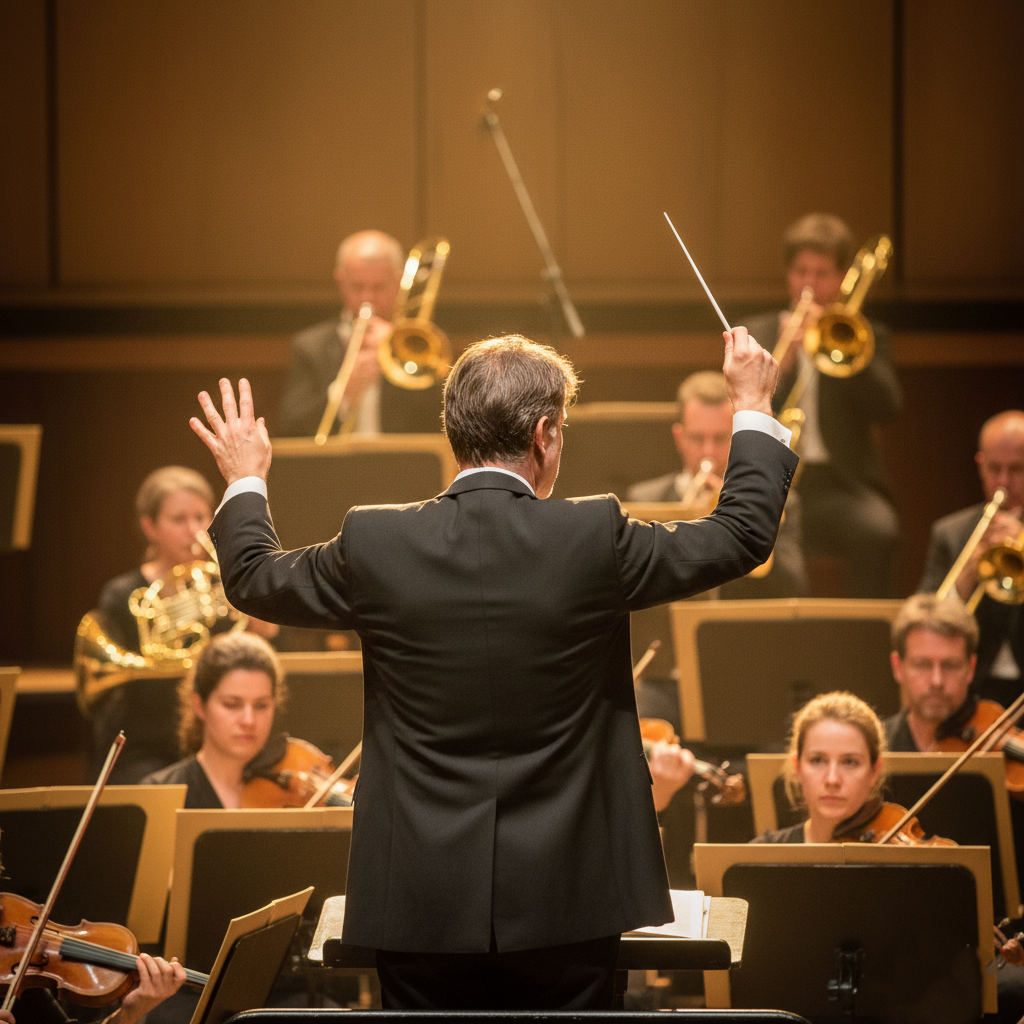
In every orchestra, the conductor represents the emotional and technical heart of the ensemble. Their figure, at the head of the musicians, embodies leadership, sensitivity, and mastery. Therefore, one of the most impactful poses is one that highlights their presence, capturing the precise moment when the baton guides the rhythm and energy of the group. This pose not only shows the conductor as the leader of the music but also as a symbol of inspiration and connection among the performers.
To achieve a powerful photograph, the conductor should be positioned in the center, with a firm yet fluid posture. The hands, especially the one holding the baton, become the focal point. The gesture can be captured in motion—a baton raised in the air or about to strike the beat—which adds dynamism and emotion to the image. Behind them, the musicians should appear attentive, following their lead, creating a harmonious composition that communicates cohesion and respect.
The lighting can come from above or from the side, creating contrasts that highlight the conductor’s silhouette against the group. Soft lighting that caresses the instruments adds drama and depth, especially if a theatrical or solemn atmosphere is desired. The use of background blur also helps to focus attention on the central figure without losing sight of the orchestra.
This pose is ideal for conveying authority and passion, showing how a single moving hand can coordinate the symphony of dozens of musical souls.
3. Highlighting individual talent
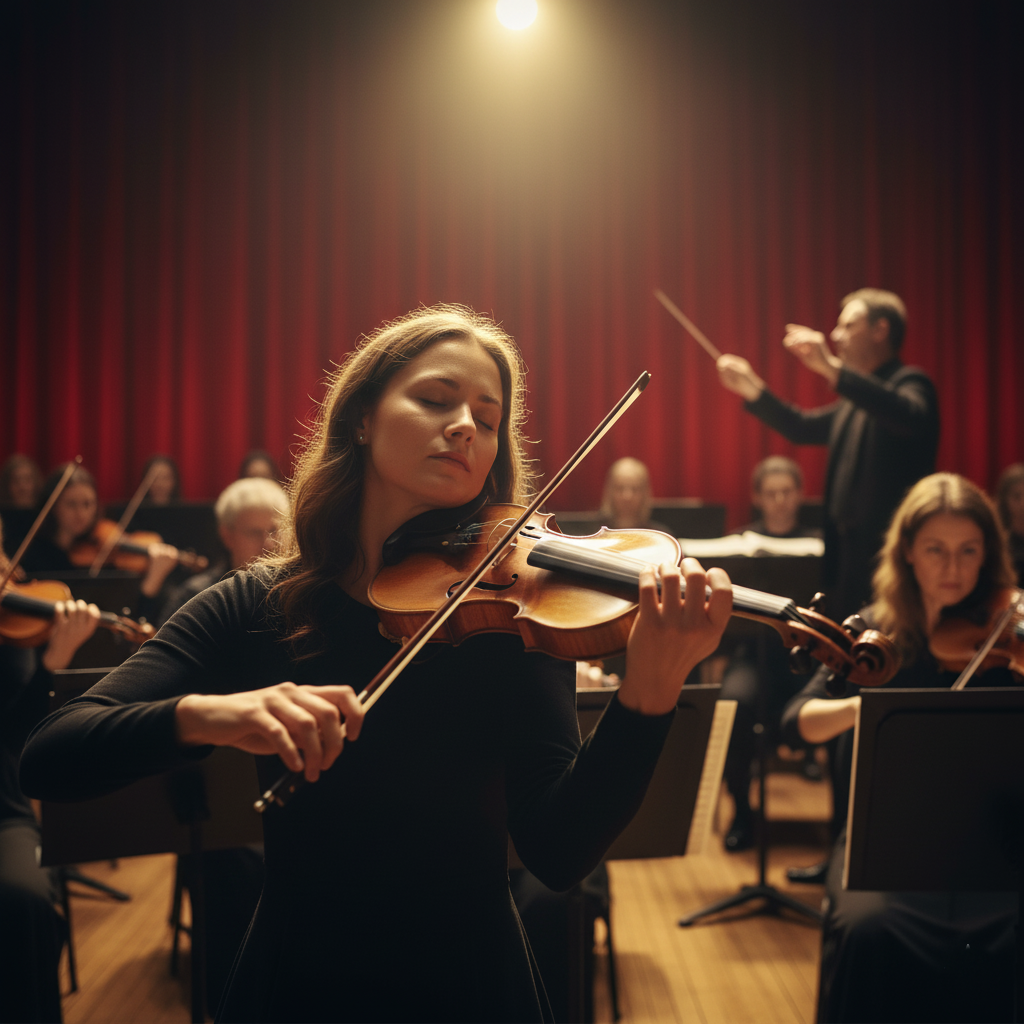
In an orchestra, each musician is part of a perfectly synchronized structure, but there are moments when a soloist takes center stage. Capturing this moment is an excellent opportunity to balance collective power with individual expression. A pose that highlights the soloist, whether a violinist, pianist, or trumpeter, allows them to showcase the passion and skill that characterize the performer of an essential part of the piece.
The visual composition should emphasize the soloist without disconnecting them from the group. Placing them in the foreground, with the other musicians slightly blurred in the background, creates a sense of depth and visual hierarchy. A focused face, firm hands on the instrument, and a natural posture convey a story of artistic dedication. This pose works especially well during the most intense moments of the performance, when emotion is powerfully reflected in facial and body language.
Lighting plays a crucial role: a warm beam of light on the soloist can symbolize the audience’s attention, while the rest of the orchestra remains in soft shadow. This creates a dramatic contrast that evokes the atmosphere of a real concert. Furthermore, capturing the shimmer of the strings or the movement of the hands adds dynamism and texture to the image.
This pose not only celebrates individual talent but also the connection between the musician and the orchestra. It shows how, even amidst many others, a single musical voice can stand out without disrupting the overall harmony.
4. Balance and Visual Composition
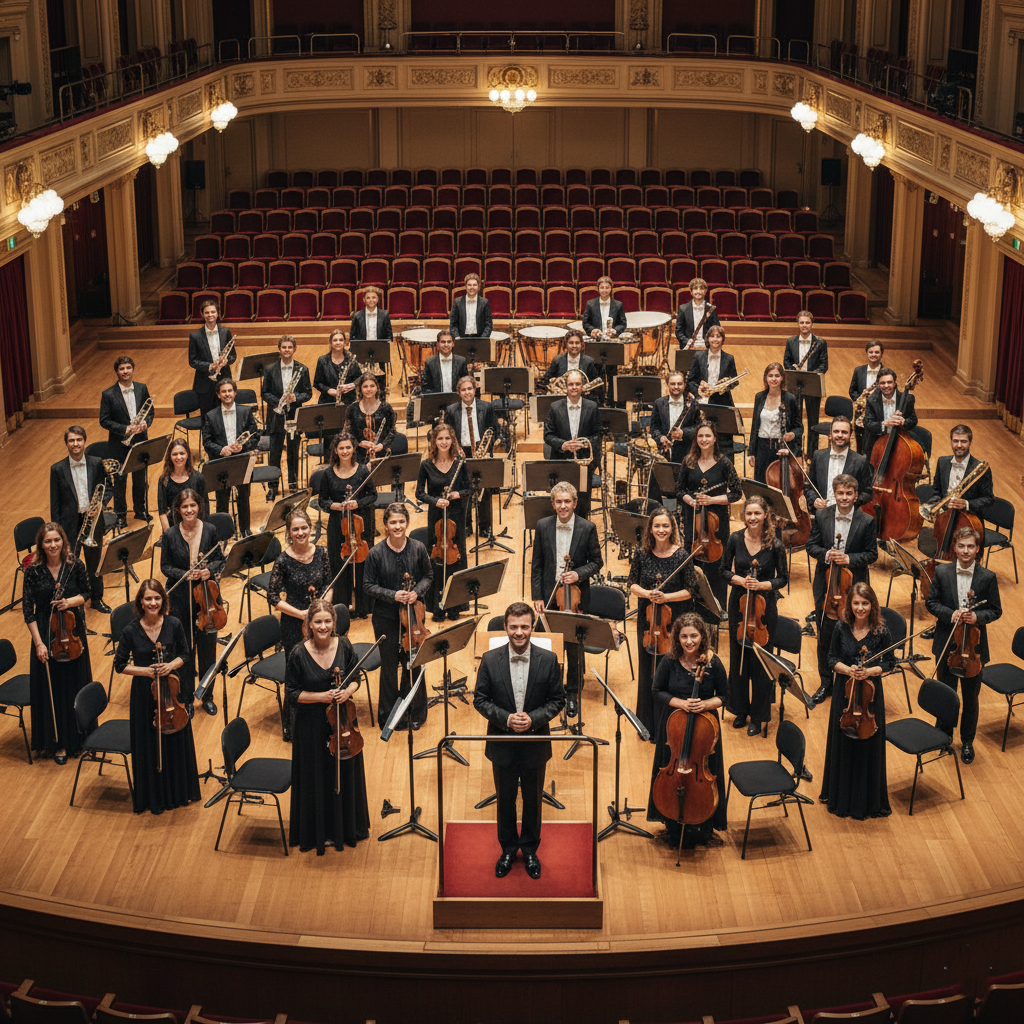
One of the most symbolic poses in orchestral photography is the one that highlights the visual harmony of the entire group. In this type of image, the goal is not to emphasize an individual, but to showcase the cohesion among the musicians and the beauty of the ensemble as a single organism. This pose requires careful planning in terms of composition, symmetry, and spatial arrangement, as the orchestra must appear balanced, both musically and visually.
The best way to achieve this is to position the musicians in a semicircular or staggered arrangement, depending on the available space. The conductor can stand in the center, baton lowered, while the performers hold their instruments at rest. The key is to convey serenity and unity: a pause after rehearsal, a moment before beginning a piece, or the silence following the last note can become the perfect moment for this shot.
From a technical standpoint, a wide shot is ideal for capturing the full magnitude of the ensemble. The lighting should be uniform but with enough contrast to highlight the materials—the metallic sheen of the metals, the polished wood of the strings, and the reflection of the music stands—creating an elegant and majestic atmosphere. This pose is perfect for portraying the orchestra as an institution: organized, precise, and full of life.
Furthermore, the visual order symbolizes the group’s internal discipline. Each musician, though individual, contributes their presence to a collective portrait that exudes synchronicity and mutual respect.
5. Emotion and shared Celebration
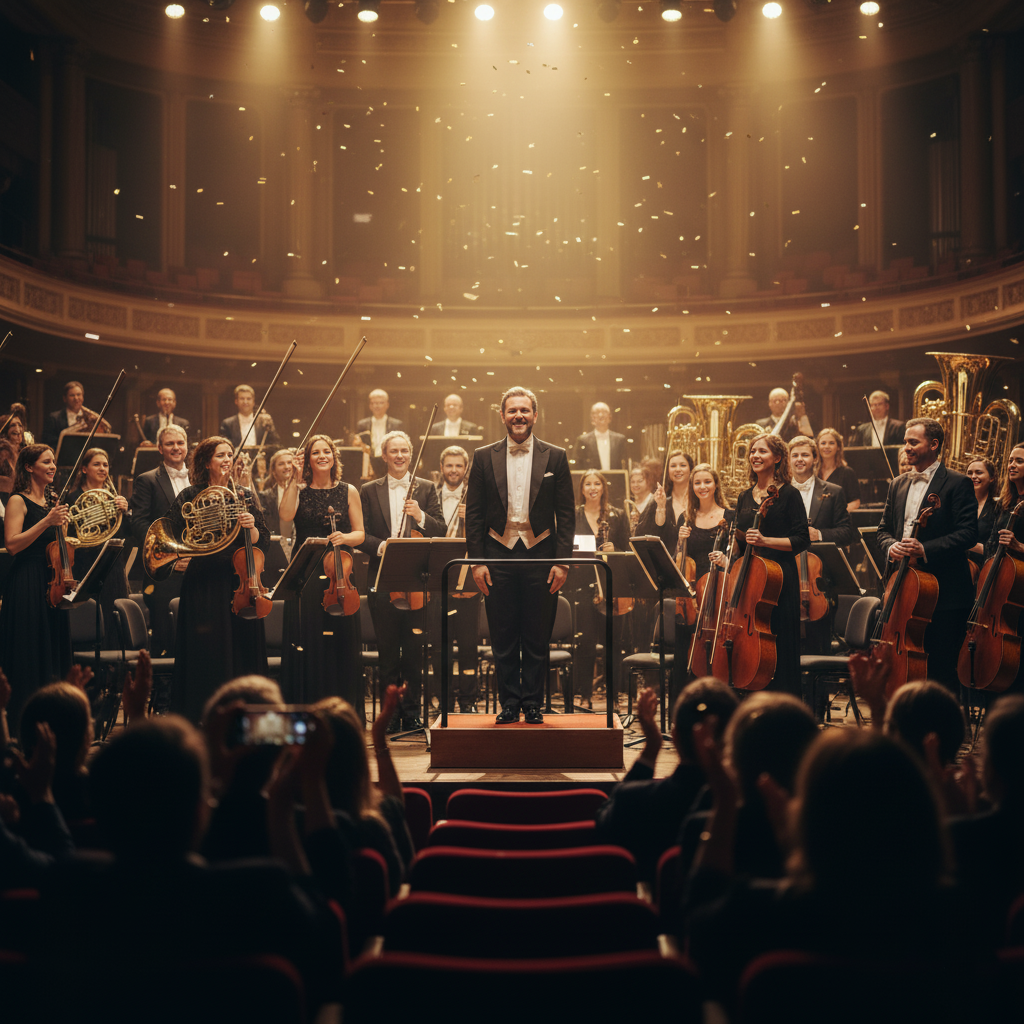
Of all the possible poses, few convey as much emotion as the final applause. This instant, when the musicians let the satisfaction of a job well done flow and the audience responds with enthusiasm, encapsulates the essence of the orchestral experience. Capturing this moment in a photograph not only documents a closing but also immortalizes the communion between the artists and their audience. It is a spontaneous pose, full of energy and authenticity, perfect for conveying pride, gratitude, and collective joy.
The ideal composition is achieved when the musicians stand, holding their instruments, some with a slight smile and others with a still-focused expression. The conductor, usually at the front, may be bowing in a gesture of gratitude or extending their arms toward the audience. This gesture creates a visual line that connects all the members and symbolizes the union between the orchestra and those who listen to them.
The photographer should aim for warm lighting that highlights the faces and the brilliance of the instruments. If the stage is surrounded by soft lights and golden reflections, the image will gain depth and drama. In this type of photograph, the movement of applause or the waving of a descending baton can create a sense of life, making the image seem to breathe music.
This pose is ideal for concluding a photographic series, as it represents the culminating moment: the culmination of collective effort, dedication, and passion. There is no rigidity or artifice, only the pure joy of shared art.
Conclusion
Photographs with orchestras not only capture the act of making music, but also immortalize the collective soul of a group breathing as one. Each pose, from the silent concentration of rehearsal to the final applause, reveals a distinct facet of musical art: discipline, emotion, coordination, and beauty. The five ideas presented demonstrate that an orchestra is more than a sum of instruments; it is a symphony of gestures, glances, and sounds that can be transformed into images brimming with meaning.
The power of these photographs lies in their ability to convey the energy of the moment. Through the lens, music becomes a visual form of emotion: the tension before a note, the serenity after a piece, the sparkle of a smile shared among colleagues. In each image, the viewer can feel the vibration of the stage, the touch of the bow on the strings, or the echo of the last measure dissolving into the air.
The key to achieving memorable photographs lies in respecting the authenticity of the moment. The poses should not feel contrived, but rather emerge from the naturalness of the rehearsal, the performance, or the celebration. The photographer becomes a silent witness, translating the sonic harmony into visual harmony, constructing a narrative that connects the art of listening with the art of seeing.
Thus, each pose becomes a story: the story of a group that plays with their hearts, shares their passion, and, through music, finds its own form of eternity in a photograph.


