

Photographing motorcycles goes far beyond simply capturing machines; it’s about conveying attitude, design, speed, and freedom. Whether for a commercial campaign, a personal portfolio, or social media content, motorcycle photos require technique, aesthetics, and a healthy dose of creativity. In this article, we share five visual ideas for photographing motorcycles in an original, powerful, and well-composed way. Whether you’re a professional photographer or a motorcycle enthusiast, these suggestions will help you elevate the visual impact of your images.
Here you’ll find ideas ranging from action shots to portraits with the rider, dramatic framing, and urban or natural settings. Each concept is designed to highlight different aspects of the motorcycle: its design, its power, its presence, or its connection to the rider’s lifestyle. We’ll also give you technical tips on lighting, composition, and scene direction so you can achieve professional results with every shot. Stay tuned to the end to discover which photographers and courses can help you further refine your visual style in this exciting niche.
1. Motion shot with panning effect to capture speed


Nothing conveys the essence of a motorcycle better than an image that captures its speed. Panning is a classic technique in automotive photography that allows you to freeze the main subject, in this case, the motorcycle and its rider,while the background becomes a trail of motion. This creates a dynamic, energetic image, perfect for conveying action, adrenaline, and direction. Mastering this effect can dramatically enhance the visual quality of your portfolio if you work with motorcycles in editorial, sports, or lifestyle shoots.
The key to panning is synchronizing the camera’s movement with the motorcycle’s as it moves. To achieve this, you need to shoot with a relatively slow shutter speed, generally between 1/30 and 1/125 of a second, depending on the vehicle’s speed. As the rider passes in front of you, you must follow them with the camera moving horizontally, keeping them in focus throughout. This blurs the background and gives the impression that everything is moving… except the motorcycle, which remains sharp and the star.
For panning to work, you need practice, but also planning. It’s ideal to work on a straight, safe, and clear street, or even on a closed circuit if you have access. Use a lens between 35mm and 85mm to maintain a medium distance and an angle that allows you to capture the entire motorcycle without distortion. As for focus, activate continuous autofocus (AF-C) to track the subject without losing precision. If you shoot in burst mode, you increase the chances of getting the perfect shot at the exact moment of maximum alignment.
This type of photo is ideal for highlighting power, speed, and control. It also works very well as advertising content, a social media cover, or part of a business portfolio. You can apply the panning effect in both natural light and with fill flash if you’re working in low-light conditions, which adds drama to the scene. The important thing is to achieve a balance between sharpness and movement so that the image speaks for itself: this motorcycle isn’t parked, it’s alive, roaring, in the heat of the moment. And you, as the photographer, captured it at the perfect instant.

2. Portrait of the rider with his motorcycle as an extension of his style


The relationship between a rider and their motorcycle goes beyond riding: it’s a form of identity. Photographing a motorcyclist with their bike allows you to capture not just a vehicle, but an extension of their personality, lifestyle, and attitude. This type of portrait isn’t simply about posing next to the machine; it’s a visual statement that communicates character, energy, belonging, and a passion for the open road. For many riders, their motorcycle is their emblem, their language, and reflecting that in an image is just as important as capturing movement.
The first thing to consider is the rider’s aesthetic. What does their clothing convey? Is it a sporty, urban, vintage, or adventure look? This should harmonize with the location and the style of the motorcycle. Look for a background that doesn’t distract but complements the image: a textured wall, a workshop, a dirt road, an old gas station, or a street with natural light at sunset. This type of portrait works best with soft ambient light or golden hour, although you can also use a single hard light source if you’re looking for drama and contrast.
Regarding body language, it’s important that the rider feels comfortable. You can ask them to lean on the bike, relax with their helmet in hand, look at the camera, or gaze towards the horizon. You can also play with natural gestures, such as adjusting their gloves, putting on their helmet, or simply crossing their arms. Use lenses between 35mm and 85mm to achieve compositions that show the subject and their motorcycle without distortion. And don’t be afraid to get close to capture half-body portraits or details of expression, always with the motorcycle present as a background element or support.
This type of portrait is ideal for personal brands, urban fashion campaigns linked to motorcycling, social media profiles, or professional branding for riders, influencers, or mechanics. It reflects style, confidence, passion, and lifestyle. Beyond the technical aspects, these images connect with the human side of biker culture: they are not just powerful machines, they are symbols of freedom, community, and character. When you manage to capture that union between human and machine, you get much more than a good photo… you get a story with its own attitude.

3. Design details: textures, headlights, engine, and body lines


A well-photographed motorcycle not only looks imposing overall, but it also shines when attention is paid to the details. Photographing elements like the headlight, the curved lines of the tank, the texture of the seat, or the gleam of the engine allows you to highlight the design, engineering, and unique personality of each machine. This approach is ideal for photographers who work with brands, custom workshops, or editorial content, as it conveys the care and aesthetics with which each motorcycle was built or modified.
The key to capturing these details is to observe with a designer’s eye: identify what makes that motorcycle special. Is it a scrambler with leather finishes? A cafe racer with matte paint? A sport bike with carbon fiber parts? Look for contrasts, reflections, repeating shapes, or unique details. Get closer with lenses like a 35mm or 50mm, and even a macro lens if you want to show textures like the pattern on a tire or the engine bolts. Play with light to emphasize volume: you can use a directional side light to create shadows that highlight the shapes.
The background in these shots should be neutral or diffused so as not to compete with the detail. If you’re outdoors, take advantage of smooth walls, dark floors, or metallic backgrounds that contrast with the motorcycle’s color. Indoors, you can use black or gray fabrics, or take advantage of industrial surfaces like concrete or corrugated metal. Natural lighting is fine, but if you want precision, use a controlled light source such as a flash with a small softbox or a spotlight. The goal is for the shape and texture to be the absolute protagonists.
These photographs are key for a professional portfolio, as they demonstrate technical mastery, aesthetic vision, and the ability to capture the visual essence of a product. They also work excellently in catalogs, websites, parts campaigns, or customization workshops. Even on social media, a good series of motorcycle close-ups generates great visual appeal. Because in the end, true motorcycle enthusiasts don’t just admire speed… they also value the small details that make them unique, and you can be the one to capture them with a precise eye and your own style.

4. Motorcycle in an urban context: architecture, graffiti or wet street


,Motorcycles are not just vehicles; they are also cultural icons, especially in urban environments. Photographing a motorcycle in a city, whether next to a concrete facade, in front of a graffiti mural, or on a wet street reflecting lights—creates a powerful visual narrative that connects speed, design, and lifestyle. The environment is not just a backdrop: it’s context, identity, character. This type of photography is ideal for telling visual stories in fashion campaigns, brand catalogs, or editorial content aimed at young, urban audiences.
The first step is choosing the right location. Look for spaces with texture, color, or geometry. A brick wall, a brutalist building, a steel bridge, a cobblestone street, or an underground parking garage can be perfect settings. Graffiti works very well if it’s integrated with the motorcycle’s aesthetic (for example, a black naked bike in front of a colorful mural). If you’re lucky enough to be working right after a light rain, take advantage of the wet pavement to reflect lights, headlights, or neon signs. These reflections can add drama without the need for extensive post-production.
In terms of technique, you can work with natural light, taking advantage of hard shadows or golden light to create contrast. If it’s nighttime, a continuous LED light or a flash with colored gels can help you dramatize the scene. Use a 35mm or 50mm lens to capture both the motorcycle and part of the surrounding environment, or an 85mm lens if you want to flatten the background and focus attention on the motorcycle’s form. Pay attention to the angle: shooting from below adds strength and presence, while shooting from above offers a more modern, editorial perspective.
This type of image has a powerful impact on social media, personal branding, and campaigns for brands with an urban aesthetic. It’s also perfect for motorcycle gear catalogs or streetwear fashion. Beyond the technical aspects, what matters is capturing that spirit of freedom within the city, where the motorcycle becomes a symbol of independence, speed, and rebellion. When you manage to merge the design of the machine with the aesthetic of the space, the result is not just a good photo: it’s a visual manifesto.

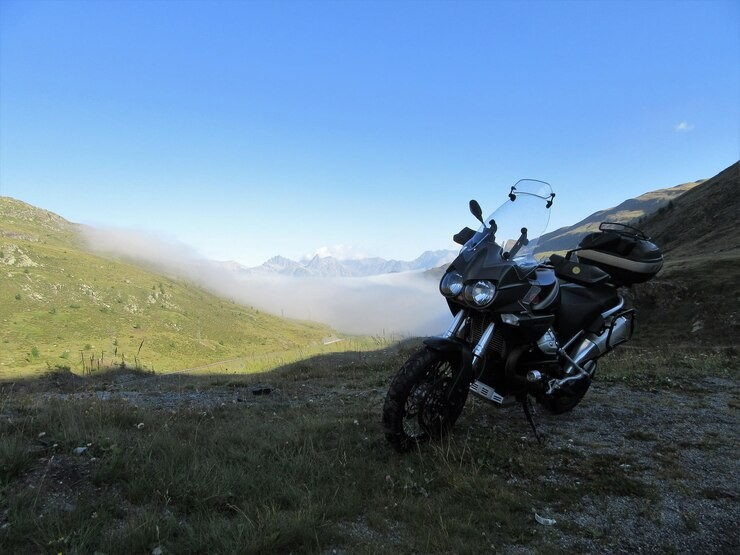
5. Lone motorcycle in a natural landscape to highlight freedom and adventure
Few images are as evocative as that of a lone motorcycle in the middle of an open landscape. This scene speaks of freedom, introspection, and a spirit of adventure. The motorcycle, as the central figure, becomes a symbol of escape, of roads yet to be explored, and of windy silences. This style of photography is ideal for editorial projects, tourism campaigns, outdoor clothing brands, or lifestyle content where the goal is to connect with deep emotions beyond the mechanical design.
Choose locations with visual impact: a vast desert, an endless highway, a misty forest, or a cliff overlooking the sea. These settings reinforce the message of chosen solitude and connection with the environment. The motorcycle should not be accompanied by people; the protagonist is the motorcycle itself and the landscape. The composition can be symmetrical, centering the motorcycle, or more editorial, placing it in the center of the image to highlight the surroundings. This type of image works excellently with dramatic skies, haze, fog, or even in a light rain.
Technically, you can work with natural light during the golden hour or even on cloudy mornings if you’re aiming for a more introspective atmosphere. Use a lens between 35mm and 85mm depending on how much depth of field you want to show of the landscape. The key is to expose well for both the motorcycle and the surroundings, so an ND filter or polarizer can be helpful if there are reflections or a very bright sky. Make sure the motorcycle is clean and well-positioned: it should look stable, in profile, or at a three-quarter angle so that its lines are clearly visible.
This type of image works very well for visual storytelling, as it connects with an emotion that many brands seek to convey: freedom. It can be part of a campaign promoting a trip, a philosophy of life, or a product linked to the spirit of adventure. It’s also perfect for album covers, magazines, travel blogs, or personal profiles of riders who live on two wheels. In this scene, less is more. And when you manage to make the viewer imagine the roar of the engine in the midst of the natural silence, then you know that you have captured more than a photo: you have captured a feeling.
Conclusion
Motorcycles offer endless visual possibilities: speed, style, character, and freedom. In this article, we explore five creative ideas for photographing them with intention and technique, from action shots to urban portraits and adventure scenes in natural landscapes. But remember: a great image doesn’t depend solely on the equipment, but on how you understand light, composition, timing… and above all, the story you want to tell. Whether you’re a beginner or a professional, there’s always room to grow and improve your visual storytelling. And that growth can begin today.


