
Vacations are that time of year when we leave our routine behind, reconnect with what we love, and, of course, take out our camera or cell phone to capture memories! But how many times have you come home with hundreds of photos that all look the same? If you want your vacation photos to really say something beyond “I was here,” you need a more creative and conscious approach. This article will give you five clear ideas for achieving this, without complicating things with professional equipment.
Whether you’re at the beach, in the mountains, in a magical little town, or simply enjoying time with your family, these ideas are designed to help you capture moments with soul. It’s not just about framing well or taking advantage of the light, but about telling little stories that reflect what you experienced. Plus, all the tips can be applied with both DSLR cameras and your cell phone. So if you want to come back from your vacation with a portfolio you’re really proud of and not just photos for the memory book, stick around. Because here begins your practical guide to taking vacation photos that are worth it.
1. Create a photo series with a theme


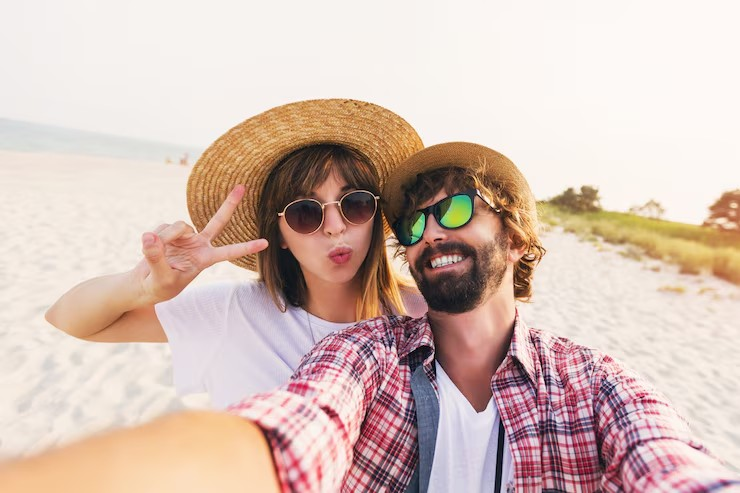
A powerful way to elevate your vacation photos is to give your collection visual unity through a themed series. Instead of shooting aimlessly, choose a concept to guide you throughout your trip: it could be colorful doors, local cuisine, your feet in different places, portraits with blurred backgrounds, or even selfies with a signature pose. This approach not only makes your photo sessions more fun, but it also helps you tell a coherent and visually compelling story when you share your photos on social media or print an album.
By working with a theme, you train your eye to spot patterns, colors, shapes, or scenes that might otherwise go unnoticed. If you choose, for example, to photograph bicycles in every city you visit, you’ll soon find yourself observing every corner more closely. The end result will be a collection with personality and a narrative that sets you apart from other travelers. Furthermore, these types of series are perfect for Instagram or blogs, as they create visual continuity and foster a stronger connection with your audience.
You don’t need a complex theme or an expensive camera to get started. Even with your phone, you can create a series of photos of shadows, reflections in the water, or your morning coffee. The key is consistency and sticking to the idea throughout your trip. You can vary the framing, play with the light, or experiment with different backgrounds, as long as the main theme remains. If you’re traveling with family, you can also create collaborative photo series: everyone takes photos under the same concept and then they combine them.
Creating a photo series during your vacation not only gives you better images, but it also changes the way you experience the trip. It makes you more mindful, more present, and much more creative. And in the end, when you look through your gallery, you’ll notice that your photos not only document the place, but also express your perspective as a photographer. That’s what truly makes an image transcend. So choose your theme, keep your eyes open, and let the story unfold image by image.

2. Capture spontaneous moments, not just poses


The best vacation photos are often not the ones we plan, but the ones that happen unexpectedly: an unexpected burst of laughter, someone splashing in the water, a knowing glance during a walk, or a child chasing a pigeon in the park. Capturing these spontaneous moments is one of the most authentic ways to document a trip because they reflect real emotions. It’s these images that, when viewed later, instantly transport you back to the exact moment and make you smile.
To achieve this, you need to stay alert, with your camera or phone always at hand and ready to shoot. Use burst or continuous shooting mode if your device allows it; that way you won’t miss the perfect moment. It’s also advisable to use fast shutter speeds (1/250 or faster) to freeze the action and avoid blurry photos. If you’re in a bright environment like the beach or the snow, take advantage of the light to achieve sharp and vibrant images. If you’re indoors or in low-light conditions, increase the ISO or find angles that allow you to take advantage of natural light.
Another key is to blend into the background. Instead of asking everyone to pose, observe from a distance. Capture how they interact with each other or with their surroundings. This applies to both family photos and street scenes in cities or towns. The less intervention there is, the more genuine the image will be. You can use a zoom lens or step back a bit so people don’t feel watched or pressured. The goal is to become a silent witness to real moments.
In the end, these spontaneous photos are often the most cherished and valued. They bring dynamism, emotion, and authenticity to your photo album. Of course, posed photos also have their place, but natural images are the ones that capture the true essence of the trip. So stay ready, observe carefully, and don’t be afraid to take many shots: among all that material, you’re sure to find visual gems that speak for themselves. Vacations fly by, but a good photo can relive that moment forever.

3. Use natural light to your advantage, especially at the beach


Light is one of the most important factors in any type of photography, but on vacation—and especially in destinations like the beach it can be your best friend… or your worst enemy. Knowing how to take advantage of it will allow you to create vibrant images with vivid colors and natural contrasts that don’t require extensive editing. The key is understanding how the light changes throughout the day and adapting to it depending on the type of photo you want to achieve.
During the first hours of the day (dawn) and just before sunset, the light is softer, warmer, and golden. These moments known as the “golden hour”—are ideal for portraits, coastal landscapes, or romantic scenes of people walking on the sand. Also, since the sun is lower in the sky, it creates long shadows that add depth and drama. If you’re looking for more emotional and atmospheric photos, this is the perfect time to shoot. You just need to choose a good angle and let the light do its work.
In contrast, at midday, the light is much harsher, whiter, and more vertical. This can cause harsh shadows on faces and a loss of detail. However, it doesn’t mean you should put your camera away. This type of light works well for capturing the turquoise color of the sea, reflections in the water, or action scenes like beach games or water sports. Just avoid portraits taken in direct sunlight, or use elements like umbrellas, trees, or structures to create partial shade and soften the contrast.
Whether you’re in the city or a rural setting, look for how the light filters through buildings, trees, or windows. Natural light can also create interesting patterns, reflections, and textures that enrich your composition. Take advantage of changing weather: a cloudy afternoon can be perfect for softly lit portraits, and a sudden storm can give you a dramatic and unforgettable scene. Learning to observe light and use it consciously is one of the best skills you can develop as a photographer. Especially on vacation, where everything changes quickly, knowing when and how to shoot can make the difference between an average photo and one that truly stands out.

4. Document objects and details that represent the Trip


Great views and family moments are essential parts of any vacation album, but there’s a type of image that’s often overlooked yet possesses incredible narrative power: the details. Photographing objects, textures, and small elements that represent your trip—like a train ticket, a local drink, sand-filled sandals, or a native flower—adds variety and depth to your collection. These details help reconstruct the complete story, not just the places you visited, but how you experienced them.
Paying close attention is key. Perhaps at a breakfast table, you find a napkin decorated with the hotel’s name, or a coffee cup next to a crumpled map. Maybe you notice the way someone hangs their hat, or how the breeze moves a curtain in front of a window overlooking the sea. They’re small things, yes, but when you put them together, they create a much richer and more personal visual narrative than just wide shots.
Technically, this type of photography works very well with wide apertures (f/2.8 or lower), which allow you to focus on the detail and blur the background to make it the star of the show. Use a prime lens or portrait mode on your phone to achieve this effect. Play with angles: you can take shots from above, from below, or get very close to highlight textures and colors. If you’re indoors in low light, look for natural light sources like windows, or use light-colored surfaces to reflect and soften the lighting.
These details also work very well as visual breaks between more complex or busy shots. You can use them to introduce a series (“this was the first thing we saw when we arrived”) or to conclude a story (“this is what I took home as a souvenir”). They’re also excellent for social media posts accompanied by a personal reflection, an anecdote, or simply a beautiful observation. So don’t underestimate the power of the small. Sometimes, a simple leaf fallen on the sand can say more about the trip than a postcard perfect panorama. It’s all about how you see it and what you choose to capture with your lens.
5. Play with unusual perspectives and angles
One of the most effective ways to make your vacation photos stand out is to break away from the typical “standing up and straight on” perspective. Changing the angle from which you take your pictures can transform an ordinary scene into something much more interesting and creative. When you dare to see from below, from above, diagonally, or through a reflection, you not only get a more striking image, but you also add your personal touch. And that, in a sea of visual content, makes all the difference.
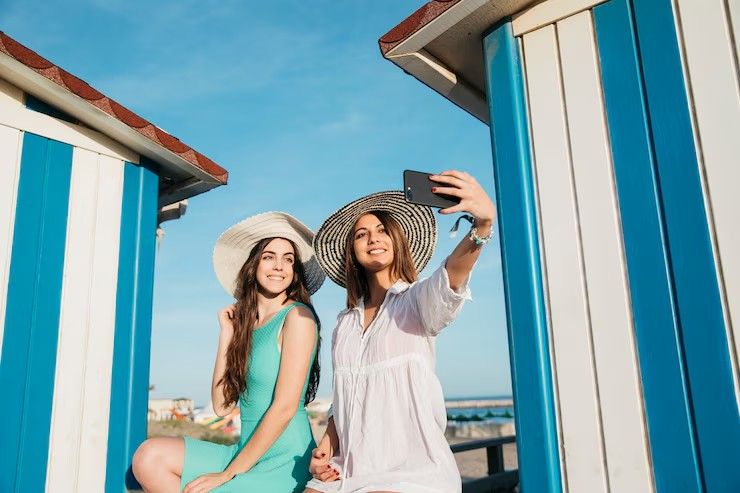
Experiment with unconventional framing. Lie down on the ground to capture the way a building rises or how palm trees are reflected in sunglasses. Climb to a high point to get a panoramic view of a plaza or a beach bursting with color and movement. Use mirrors, windows, puddles, or even your phone screen to play with reflections. Don’t be afraid to get a little dirty, move around a lot, or look like “the odd one out” with the camera in an unusual position. These risks often yield the best results.
You can also change your perspective by playing with focal length: a wide-angle lens (or the wide-angle mode on your phone) will help you exaggerate depth and capture more elements in a single shot. Conversely, a telephoto lens will compress the scene and highlight details that seem insignificant from a distance. Alternating between these approaches during your trip will give you visual variety that will make your final photo gallery much more appealing. The trick is to pause for a few seconds before taking the photo and ask yourself, “Where else can I see this from?”
Playing with perspectives forces you to be more present, to explore each place beyond the surface, and to actively engage with your surroundings. This exploration, in addition to improving your photos, gives you a richer and more mindful travel experience. So the next time you arrive at a destination and everyone is taking the same photo from the same angle… look for a different one. Move closer, move further away, lean forward, or climb to a high point. You’ll see how each image becomes something unique and truly yours.

Conclusion
Make your vacation photos tell a story. Your vacation deserves more than just generic snapshots. It deserves images that capture how you experienced each place, each moment, each emotion. Applying these five ideas will help you move beyond the typical “snapshot” and create a visual collection that reflects your style, your perspective, and your personal story. Whether you take photos with your phone or a professional camera, the important thing is to look with intention and compose with emotion. That’s the key to making your memories unforgettable visually as well.


