

Outdoor urban dance has become one of the most captivating visual expressions for contemporary photography because it combines movement, attitude, and the unique character of the urban environment. Each street, park, or architectural structure offers a distinct dialogue with the dancer’s body, creating images that convey freedom, energy, and authenticity. Unlike enclosed spaces, open locations allow photographers to play with the wind, natural light, and the unexpected elements that are part of the city. Urban dancers find in these settings the perfect space to showcase the power of their technique and the spontaneous essence of their style, while the photographer can capture moments full of personality and rhythm. The key lies in choosing poses that enhance the dynamism of the dance but also adapt to the environment, integrating urban lines, textures, and shadows to build a coherent and vibrant visual composition.
Exploring specific poses for outdoor urban dancers involves observing how the body interacts with the surrounding space. A pose can be framed within colorful graffiti, integrate movement with the hardness of the pavement, or contrast the lightness of a leap with the solidity of a building. Each pose represents not only a technical gesture but also an attitude: rebellion, fluidity, strength, ease, introspection, or confidence. Urban photography allows the dancer to move freely and the photographer to capture the essence of the moment, from the tension of a precise jump to the profound calm of a pause in the heart of the city. The connection between dance and urban landscape generates images charged with stage energy, where the dancer becomes the protagonist of a narrative that blends art, movement, and the vibrant pulse of the modern city.
1. The pose of the expanded urban leap

The urban leap is one of the most striking poses for an outdoor dancer because it captures the force of movement at its peak and creates a sense of absolute freedom that directly engages with the city’s open spaces. This pose involves executing a wide jump where the legs extend and the arms follow the body’s line, generating a figure that seems to momentarily defy gravity. The power of this pose lies in the precise tension of the body, the determined gaze, and the dancer’s ability to project energy outward while suspended in the air. In urban environments, this type of jump takes on a special dimension because it contrasts the lightness of the movement with static visual elements such as walls, pavement, or metal structures. For the photographer, capturing the exact point of elevation is crucial because it is at that moment that the body becomes almost sculptural and the city seems to pause to frame the gesture.
The urban leap not only conveys technique but also an attitude of empowerment and mastery of space. As the dancer rises, her body seems to claim a visual territory amidst the rigid architecture that surrounds her. The sensation of expansion creates a direct dialogue between the body and the urban landscape, reinforcing the idea that dance can transform even the most mundane settings into moments of visual poetry. Natural light is a key ally in this pose, especially when photographed at sunset or at times when shadows cast dramatic shapes on the ground. The pose is ideal for showcasing confidence, energy, and the versatility of urban style, demonstrating that movement can break any physical or aesthetic barrier when combined with the creativity of the environment.
2. The pose of the lateral support with urban torsion
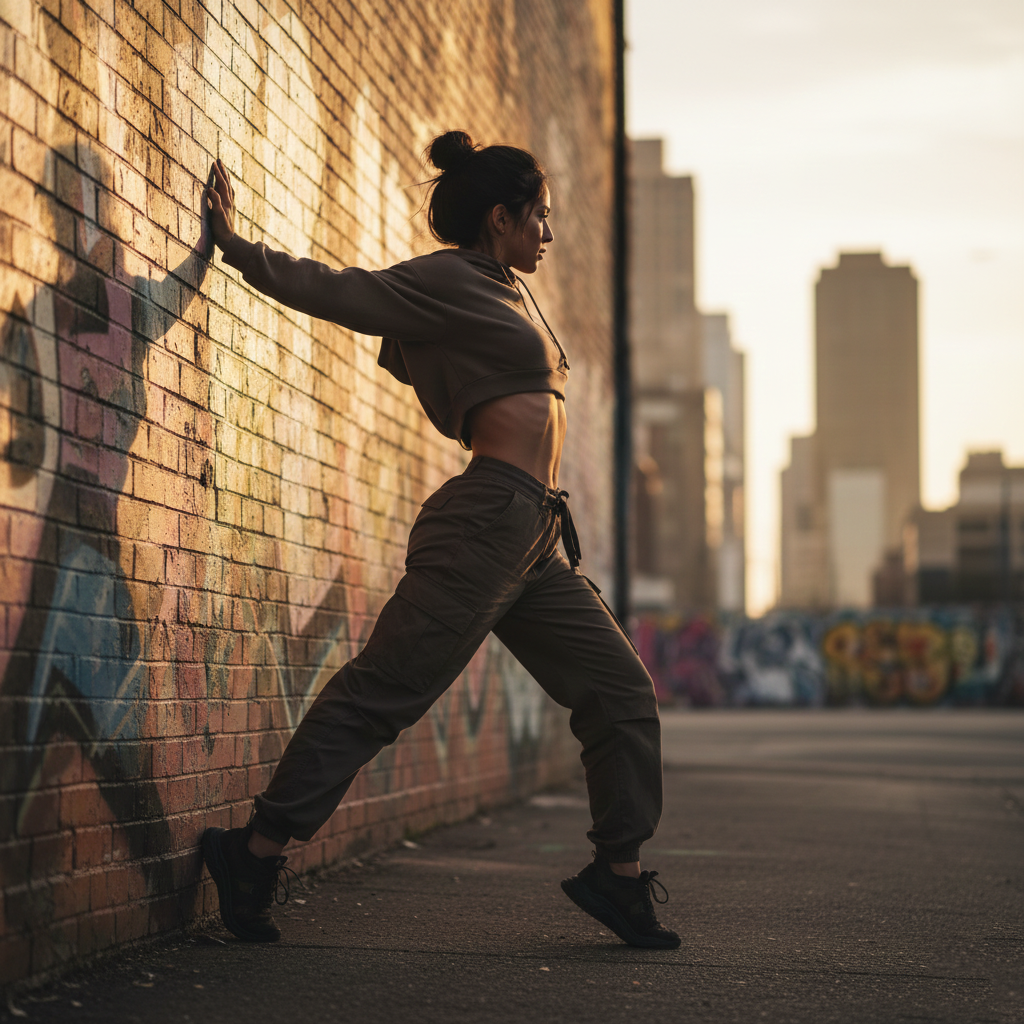
The urban twisting side support is a pose that combines strength, flexibility, and an attitude marked by the identity of street dance. This concept is based on using an architectural element—such as a wall, a column, a railing, or even a painted container as a point of contact to generate a dynamic and expressive body line. The dancer places a hand or part of their forearm on the chosen surface and, from this firm support, twists their torso outward, allowing the body line to expand in a powerful diagonal that highlights both technique and urban aesthetics. This pose creates a visual interaction between the body and the environment, integrating textures such as cement, brick, or graffiti, which add character and define a narrative linked to the city and its vibrant energy.
The appeal of this pose lies in the contrast between the solidity of the urban element and the fluidity of the dancer’s body. The twist transforms the figure into a living composition, full of controlled tension, where the gaze can follow the opening of the torso or be directed toward the camera to convey attitude. This pose allows you to play with the body’s shape and take advantage of the natural lines of the environment to reinforce the visual composition: a long wall can extend the body’s diagonal, a shadow can accentuate the torso’s curve, and colorful graffiti can highlight the expressive power of the movement. The side-legged twist pose allows you to explore a more introspective or defiant side of the dancer, depending on her facial expression and the intensity of her gesture. Furthermore, as a static pose with inherent power, it allows the photographer to focus on details such as lighting, background texture, and body alignment without losing the energetic essence of the urban style.
3. The pose of flowing in motion with loose clothing

The flowing pose in loose clothing is one of the most expressive in outdoor urban dancer photography because it showcases not only body technique but also the dynamism generated when the clothing becomes an extension of movement. This idea is based on using loose garments such as sweatshirts, open jackets, flowing skirts, or lightweight pants, allowing each turn, undulation, or shift to produce an immersive visual effect. The body doesn’t need to adopt a rigid posture; on the contrary, the dancer is invited to let herself be carried away by the internal rhythm, creating fluid movements that feel natural and connected to the urban environment. The gesture can begin from the torso, continue through the arms, and expand progressively to the legs, as if the wind and the clothing were active participants in the dance.
This pose stands out because it conveys pure emotion. The continuous movement generates a sense of freedom that is amplified when the fabric begins its own journey through the air, leaving visual traces that accompany the figure. In open settings like parks, wide streets, or plazas, this type of pose allows photographers to capture the interaction between the dancer and the environment, as if the city itself were responding with light, shadows, or air currents. The photographer can use slower shutter speeds to capture the movement or faster ones to freeze the precise details of the suspended fabric. The final result has a poetic power that highlights the dancer’s personality, her expressiveness, and the vibrant energy of urban dance. This pose invites play, exploration, and the creation of images where spontaneity becomes art and where the costume takes on the role of a supporting character, naturally complementing each gesture.
4. he pose of active rest on an urban curb

The active rest pose on an urban curb is a perfect representation of the balance between attitude, pause, and stage presence within the urban dance style. Although it might seem like a simple pose, it actually requires subtle body control to express energy even at rest. This idea is based on using a curb, step, or low bench as a support, allowing the dancer to adopt a position that simulates a moment of recovery after an intense movement, but without losing the expressive essence of the dance. The body leans slightly forward, with the elbows resting on the knees, creating a sense of contained inner tension. The gaze can be directed downward in a reflective gesture or toward the camera with a defiant touch, depending on the intention to be conveyed.
The power of this pose lies in the combination of a relaxed attitude and the contained energy within the posture. Active rest allows for the highlighting of details that often go unnoticed in dynamic poses: the firmness of the legs, the precise posture of the torso, the facial expression that reveals concentration or calm, and even the interaction with elements of the environment such as shadows or the textures of the pavement. It is a pose that provides an effective visual contrast because it places the dancer in a moment of stillness within an urban environment full of rhythm and movement. Furthermore, it serves as a narrative transition within a photographic series, offering respite between highly dynamic images and allowing for the exploration of a more introspective facet of urban dance. Natural light, especially that which comes from a side angle, can accentuate the body’s silhouette and highlight the lines of the pose, creating a powerful photograph despite (or perhaps precisely because of) its apparent simplicity.
5. The vertical extension pose on an urban railing

The vertical extension pose on an urban railing is one of the most elegant and powerful in outdoor dancer photography because it combines the technical strength of dance with the raw, linear aesthetic of the urban environment. This pose uses a railing, a metal fence, a park fence, or even a stair structure as a support to create a vertical line that rises with intensity. The dancer holds the railing with both hands or one, depending on her balance and flexibility, while raising one leg upward in a long, controlled extension that traverses the space from bottom to top. The pose generates a magnetic contrast: the softness of the movement meets the hardness of the metal, and the body traces an upward line that seems to defy the very structure of the location.
This pose not only demonstrates technique but also determination because it demands stability, core strength, and a clear artistic intention. The verticality of the body allows the photographer to play with perspective, reinforcing parallel lines between the dancer’s posture and the surrounding architectural elements. A metal fence can create repetitive patterns that accentuate the extension; An urban bridge can add depth; a high railing can create a contrast between the ascending figure and the landscape unfolding in the background. Furthermore, this pose offers a perfect opportunity to capture tension and serenity simultaneously: the raised leg expresses effort and precision, while the face can convey calm, focus, or a defiant attitude. Natural light acts as an ally, especially that which falls from above the urban environment, creating a visual effect that emphasizes the dancer’s verticality and slender figure. The final result is a powerful image that combines artistry, physical strength, and the authentic character of the urban landscape.
Conclusion
Photographs of urban dancers outdoors have become a powerful way to capture the strength, rhythm, and freedom that dance imprints on the body. These images demonstrate how the urban environment can become a living stage where every movement finds a visual echo in the textures, lights, and contrasts of the city. Each pose, from explosive leaps to the most introspective postures, shows that dance is not only performed but also felt, breathed, and transformed into a language that transcends the physical. Outdoors, the dancers face the wind, the sounds, and the unpredictable elements, making each shot an unrepeatable instant, a pure connection between body and space.
Furthermore, these poses showcase the technical discipline that urban dance demands and, at the same time, the emotional authenticity that characterizes it. The photographer becomes a privileged witness, able to freeze moments of grace and energy that often occur in fractions of a second. The city ceases to be a mere backdrop and transforms into a complementary character that contributes attitude, texture, and meaning. Through these ideas, it is demonstrated that photographing urban dancers is fertile ground for creativity, where spontaneity and intention converge in images that tell stories of resilience, style, and personal expression.


