

Photographing skaters in motion captures the pure essence of the sport: speed, balance, risk, style, and an intimate relationship with the urban environment. Unlike static poses, images in motion require synchronization between the photographer and the skater, as every second offers a different body shape, an unexpected shadow, or a spontaneous gesture that lasts only an instant. Skaters move with a fluidity that combines strength and technique, making each action a stimulating visual opportunity. Documenting these moments involves understanding how the body adapts to inertia, how the board interacts with the pavement, and how speed transforms even the simplest details of the environment into part of the photographic narrative.
Skateboard photography in motion is ideal for urban settings because the architecture provides lines, textures, and structures that integrate naturally with the skating style. Railings, stairs, ramps, and walls become key elements that not only complement the pose but also tell a story about the skater’s skill level and the personality of the shot. The interplay of light and shadow in the urban landscape adds depth, drama, or a cinematic touch that elevates every image. In these contexts, the photographer must anticipate the action, predict trajectories, and be ready to freeze the precise energy the skater infuses into the trick or movement.
Capturing a skater in action also reveals more than just technical skill: it showcases attitude, personal style, and the emotional connection each person establishes with their board. Whether it’s a simple movement or a complex trick, the goal is to make the photograph convey the energy felt when you’re near someone flowing freely on wheels. The following ideas explore different poses in motion that can transform a skate session into a vibrant, expressive, and dynamic visual experience.
1. Forward displacement with constant momentum to capture natural speed

One of the most essential and versatile poses when photographing skaters in motion is the front-facing shot, where the skater moves fluidly toward the camera while maintaining a steady pace. This type of shot captures the essence of skateboarding without requiring a complex trick, because the body posture, arm movements, and the way the board glides speak for themselves. The key is to ask the skater to maintain a steady stride, with their torso slightly leaning forward and knees bent for stability. This body angle is not only natural but also conveys energy, determination, and a continuous sense of forward motion.
During this movement, the photographer can play with different perspectives to achieve more impactful visual effects. A shot from a low angle makes the skater look more imposing and highlights the board as a key element. If the camera is positioned at ground level, the texture of the pavement and the movement of the wheels create a special drama that intensifies the sense of speed. On the other hand, keeping the camera moving—by slightly pulling back or using a smooth pan—can create a blurred background effect that adds a dynamic, almost cinematic touch.
The environment also plays a crucial role. A long street, an urban corridor between buildings, or a park with wide paths allows the skater to move uninterrupted and creates vanishing points that guide the eye directly to them. This type of photography captures not only the action but also the skater’s attitude: the facial expression, the relaxed shoulder position, and the way they look ahead reflect confidence and mastery of the movement. Therefore, even though the pose may seem simple, it is one of the most effective for conveying essence, style, and authenticity.
2. Wide turn in a curve to show fluidity and mastery of space

The wide turn is one of the most expressive poses for photographing skaters in motion because it combines technical control, body grace, and a direct connection with the environment. This type of movement reveals how the skater uses their weight, lean, and the board’s flexibility to trace a perfect curve on the pavement. The body adopts a slanted posture that, viewed from certain angles, is visually powerful: the hips subtly drop, the shoulders rotate in the direction of movement, and the arms open organically to maintain balance. It’s a pose that conveys fluidity and mastery, as if the skater were drawing an invisible line on the ground.
To capture this type of photograph, it’s important to anticipate the exact point where the skater will begin the turn. This allows the photographer to position themselves at an angle that showcases the body’s natural lean. A side shot highlights the complete gesture of the turn, including the torso twist and the board’s movement, while a slightly diagonal front shot emphasizes the sense of movement and the interplay between the wheel, the surface, and the direction of the turn. Wide turns create visual harmony because they integrate action and serenity in a single instant, resulting in balanced, clean, and purposeful images.
The urban environment works especially well for this type of pose, as the lines of the pavement, the edges of sidewalks, or even the shadows cast by buildings help to visually guide the curve. It’s also a great opportunity to play with lighting: backlighting accentuates the silhouette and creates a bright edge on the body, while side lighting highlights the muscles, the board, and the tension of the movement. The curved turn thus becomes a perfect pose for conveying fluidity, direction, and an aesthetic marked by freedom of movement.
3. Diagonal Sliding with Dynamic Flow

The diagonal slide is a pose that combines movement, direction, and a sense of continuous transition, perfect for conveying the authentic energy of skateboarding in action. This concept focuses on capturing the skater as they traverse the frame at an angle that breaks the classic horizontal or vertical composition. By working with a diagonal, the image acquires a distinct visual impact, as the viewer feels that the movement not only advances but also cuts through space, creating tension and speed. To achieve this pose, the skater should move from a high point or a smooth ramp, allowing the incline to enhance the natural flow. During the slide, the body can lean slightly toward the center of the curve, while the arms help stabilize and direct the movement, generating lines that complement the main diagonal. In this pose, the face doesn’t need to be the focus; instead, body posture, leg angle, and the way the board follows the visual path are the key elements.
The essence of this idea is to capture the moment the board is perfectly aligned with the imaginary diagonal line running through the frame, while clothing, hair, or accessories create a subtle trail of movement. It’s important to choose a background that doesn’t compete with the body’s main direction, such as smooth walls, wide paths, or ramps with subtle textures. Side lighting can emphasize volume, creating shadows that accentuate the power of the movement. This pose works particularly well when aiming for a more editorial or artistic style, as its composition naturally breaks the mold and generates greater visual impact compared to more traditional shots.
4. Side slide with urban energy
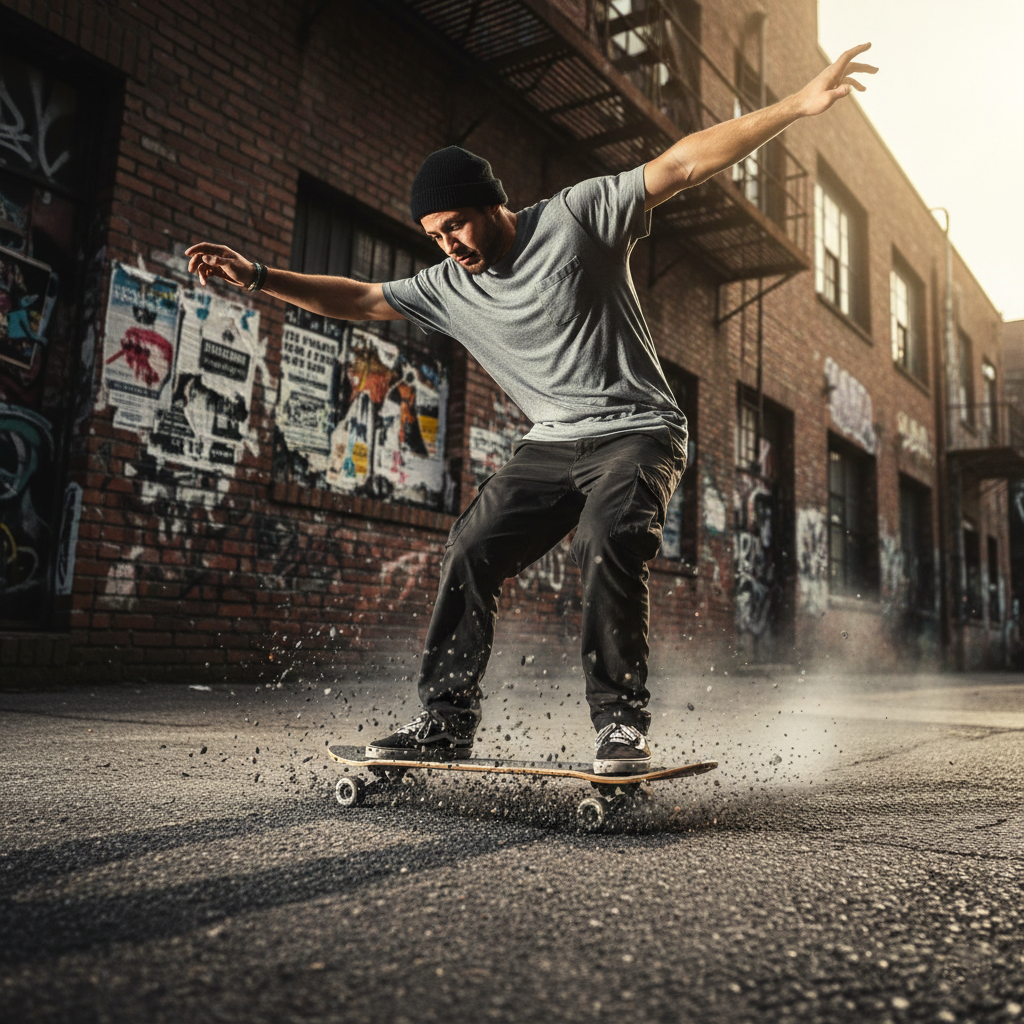
The side slide, also known as a powerslide, is one of those poses that conveys a perfect blend of control, speed, and an authentic urban vibe. To transform it into a memorable photograph, it’s essential to consider the fluidity of the movement and the skater’s body language. In this type of pose, the intention isn’t to capture a complicated technical trick, but rather that split second in which the skater slows their momentum with a slight skid, letting the board tilt just a few degrees while the body remains stable, shoulders open, and gaze forward. This is a pose that communicates attitude, command of space, and an almost cinematic feeling of being in a vibrant street, full of rhythm and dynamism.
The key to creating this photograph is choosing an angle that emphasizes the friction between the wheels and the pavement. A lower frame, closer to the ground, allows the dust or small particles kicked up by the skid to become the visual focus. Furthermore, this angle helps to stylize the skater’s body lines, making the pose appear more defined and fluid. Loose clothing, contrasting colors, and an urban backdrop—such as textured walls, graffiti, or an alleyway bathed in natural light—help reinforce this street aesthetic so characteristic of skate culture.
The ideal moment to press the shutter is just as the skater shifts their weight to the side of the slide. This instant offers a perfect balance between movement and stability, giving the pose a powerful presence, almost as if the skater were consciously posing despite being in the middle of the action. The result is an image that exudes freedom and technical skill without appearing exaggerated.
5. The controlled mid-air spin

Performing a mid-air spin is one of the most captivating maneuvers in the world of skateboarding, not only for the technical skill it demands but also for the visual expressiveness it generates when captured correctly in a photograph. To create a pose that truly conveys the emotion of the movement, it’s essential that the skater maintains an open, flexible posture, fully focused on the rotation. The ideal image typically captures the highest point of the jump, where the body is suspended for a fraction of a second, allowing the spin to be perceptible without losing clarity in the pose. In these types of shots, it works very well for the skater to have their arms slightly extended outwards, as this provides balance while also revealing the natural tension of the movement.
To enrich the visual narrative, the photographer can look for an angle that emphasizes the trajectory of the jump. A low angle, almost at ground level, helps the rotation appear wider and more dramatic, while a side shot captures the curve and fluidity of the spin with greater elegance. It’s also helpful to incorporate elements of the environment, such as railings, ramps, or streetlights, to convey the height achieved and the energy of the trick. The intention of this pose is not only to show skill but to make visible the exact moment the body defies gravity, creating a feeling of total freedom.
The skater should focus on keeping their face relaxed and their gaze fixed on the point where they plan to land, as this gives direction and purpose to the final image. The legs should support the spin firmly, with the board well-aligned, conveying control without losing the naturalness of the movement. If all of this is harmonized, the resulting photograph manages to capture not just a trick, but a complete story in a single frame.
Conclusion
Skateboard photography is a vibrant fusion of speed, technique, and personal expression, and capturing it effectively requires a balance of observation, anticipation, and artistic sensibility. Throughout these five ideas, we explore how every pose, every gesture, and every instant has the power to transform a simple shot into an image brimming with energy and meaning. The key lies in understanding that skateboarding is not just a sport, but a form of visual communication where every trick, every boost, and every fall tells a story. For the photographer, this means immersing themselves in the scene, feeling the rhythm, listening to the sound of the wheels gliding, and recognizing when that perfect moment is approaching, the moment when the action reaches its most expressive point.
In closing, it’s worth remembering that no single technique works in isolation; the magic happens when we combine mastery of movement with the right light, the correct angle, and the skater’s willingness to authentically showcase their style. Exploring new perspectives, experimenting with different shutter speeds, and playing with the distance between the camera and the subject expands creative possibilities and allows us to create images that convey genuine dynamism. Furthermore, working alongside the skater, discussing their favorite trick or the spot on the course where they feel most comfortable, opens the door to more natural and powerful shots. Each photograph then becomes a collaboration, a shared quest to freeze a moment that would otherwise vanish with the speed of the movement.
In conclusion, photographing skaters in motion is an exciting field where photographers can experiment, hone their skills, and enjoy the constant challenge of capturing the essence of movement. With practice, patience, and creativity, each session becomes an opportunity to capture a world where adrenaline and art converge.


